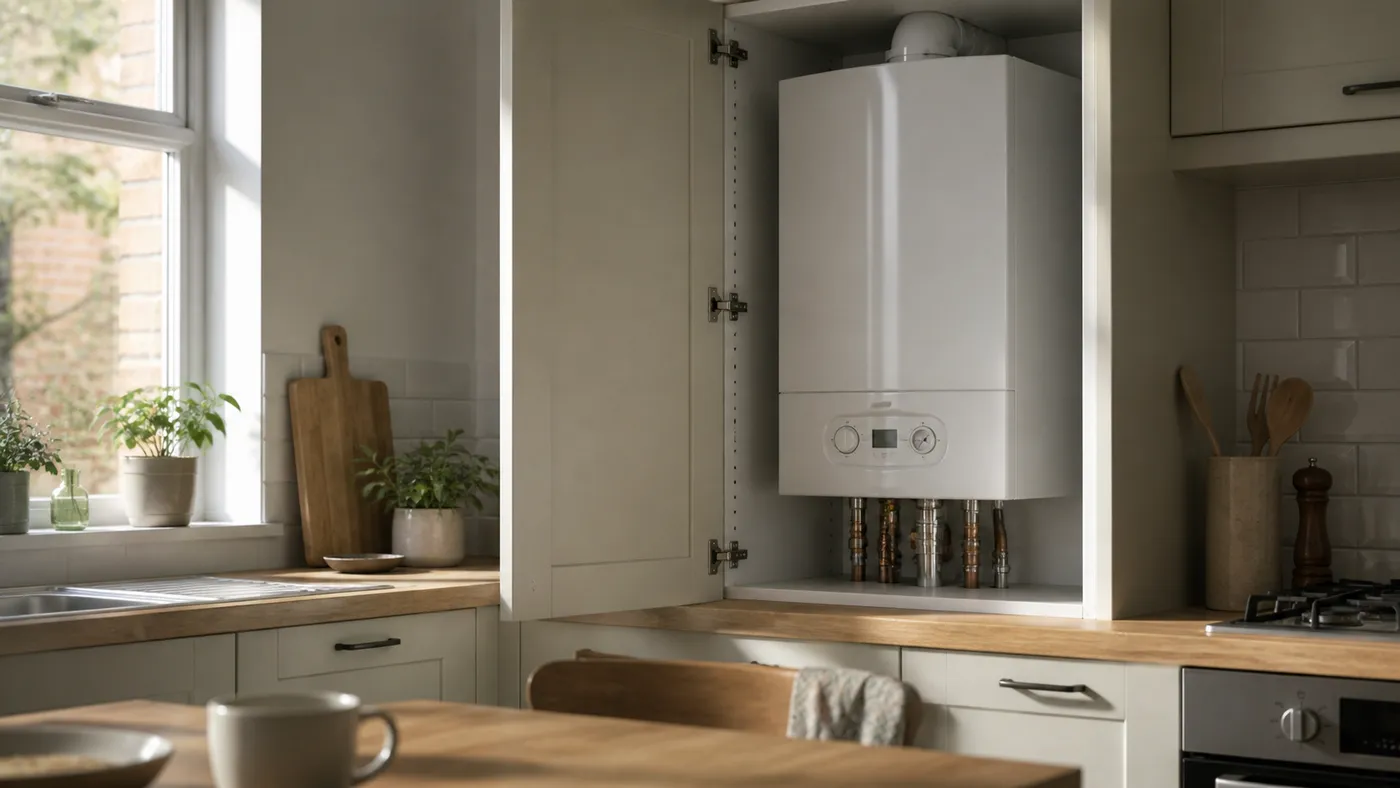
A plain explanation of what happens inside a gas boiler, how combis and system boilers differ, and which worn parts make replacement the better answer.
A gas boiler works by burning gas in a sealed chamber and passing the heat into water through a heat exchanger. A pump then pushes that hot water round your radiators, and either heats a hot water cylinder or, in a combi, heats tap water instantly as it flows through. A fan, an ignition system, sensors and a circuit board control the whole process, and a flue carries the exhaust gases outside. Knowing what each part does makes it much easier to judge a repair quote against a replacement.
The heating cycle, step by step
When the thermostat or timer calls for heat, the boiler runs a short start-up sequence and then keeps the water at the temperature it has been set to. In simple terms, it goes like this.
- The fan starts and clears the combustion chamber, and a pressure sensor confirms the flue is drawing properly.
- The gas valve opens and an ignition electrode sparks to light the burner.
- A flame sensor confirms the flame. If it does not detect one within a few seconds, the gas valve closes and the boiler locks out rather than keep releasing unburnt gas.
- The heat exchanger takes the heat from the flame and hot exhaust and passes it into the water inside it.
- The pump circulates the water through the pipes and radiators and back to the boiler.
- The boiler modulates, turning the flame up or down to hold the flow temperature, and shuts down when the thermostat is satisfied.
None of these components should be adjusted or opened by a householder. Work on gas appliances must, by law, be carried out by a Gas Safe registered engineer.
How condensing boilers get extra heat
A condensing boiler cools its exhaust gases enough for the water vapour in them to condense, and that releases heat that an older boiler threw away up the flue. It is why every new gas boiler has a plastic condensate pipe.
The condensing only happens when the water returning from the radiators is cool enough. A boiler running at a high flow temperature all the time condenses very little, which is why sensible flow temperatures, correct sizing and good controls matter as much as the boiler itself. The difference between condensing and combi, which people often confuse, is explained in condensing boiler vs combi boiler.
How a combi makes hot water on demand
A combi uses a diverter valve to switch between heating and hot water. When you open a hot tap, a flow sensor detects the water moving, the diverter sends the boiler's heat to a small plate heat exchanger, and mains water is heated as it passes through.
While the tap is running, the heating is paused, which is normal and usually unnoticeable. The flow rate of hot water depends on two things: the output of the boiler and the flow of cold water coming into the house. A larger combi cannot give you more hot water than your mains delivers, which is why sizing a combi means measuring the mains flow, not just picking a bigger number. What a combi boiler is and who it suits goes into this in more detail.
How system and regular boilers heat a cylinder
System and regular boilers do not heat tap water directly. They heat water that runs through a coil inside a hot water cylinder, and motorised valves decide whether that heat goes to the cylinder, the radiators or both.
A system boiler has its pump and expansion vessel built in and runs on a sealed, pressurised heating circuit, topped up from the mains through a filling loop. A regular boiler relies on parts outside the boiler: a separate pump, and a feed and expansion tank in the loft that keeps the heating circuit topped up and absorbs expansion. Because the cylinder stores hot water, both can supply several showers at once, provided the cylinder is big enough and recovers fast enough.
The safety and pressure parts
A sealed heating system has parts whose only job is to keep pressure and temperature within safe limits. They are the parts most often involved when a boiler starts losing pressure.
- Expansion vessel: a pressurised chamber that absorbs the expansion of the water as it heats up.
- Pressure relief valve: releases water through a pipe outside if the pressure rises too high.
- Pressure gauge: shows the system pressure, usually somewhere between 1 and 1.5 bar when cold on most boilers, though the manufacturer's figure applies.
- Overheat thermostat and flue sensors: shut the boiler down if it runs too hot or the flue is blocked.
What wears out, and when that points to replacement
The parts that wear are mostly the moving and electronic ones: pumps, fans, diverter valves, gas valves and circuit boards. Replacing one of these on a boiler that is otherwise sound is usually a sensible repair.
The calculation changes when the part is the heat exchanger, when several parts fail in a short period, or when the boiler is old enough that parts are hard to find. A cracked or corroded heat exchanger on an older boiler is often the point where replacement makes more sense than repair, and any quote should say so plainly. The broader signs are in signs you need a new boiler.
What this means when you replace a boiler
Understanding the parts helps you judge whether the new boiler has been specified properly. The boiler is only one part of a system, and the system decides how well it performs.
A good replacement quote should name the boiler type and output, explain how the output was worked out, state whether the flue and condensate routes change, include a system clean and a magnetic filter to protect the new heat exchanger, and list the controls being fitted. If the existing cylinder, radiators or pipework are unsuitable, that should be written down too. Our new boiler installation survey works through each of those points before a fixed quote is given, and if a repair to your current boiler is the better answer, you will be told.
Frequently asked questions
Why does my combi stop heating the radiators when I run a hot tap?
That is normal. A combi uses a diverter valve to send all of its heat to the hot water while a tap is running, then switches back to the heating when the tap closes.
What is the most expensive part of a boiler to replace?
The heat exchanger is usually the costliest part. On an older boiler, a failed heat exchanger is often the point at which replacing the boiler makes more sense than repairing it.
Can I fix or adjust my gas boiler myself?
No. Any work on a gas appliance must by law be carried out by a Gas Safe registered engineer. You can check the pressure gauge and your controls, but the boiler casing should not be opened.